We assess each legacy application, choose the right path, from rehosting to a full rebuild, and modernise it while it stays in production.
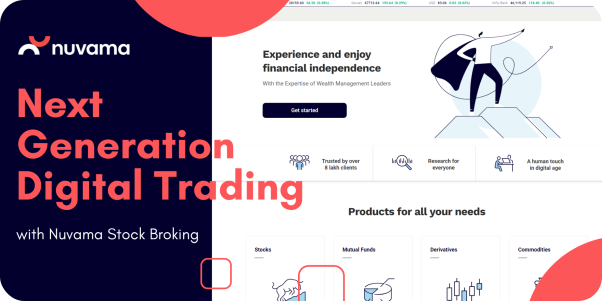
sees a 4x increase in transaction volume
Most portfolios need more than one approach. We assess each application on business value, technical condition and risk, then recommend a path per system rather than one pattern for the whole programme.
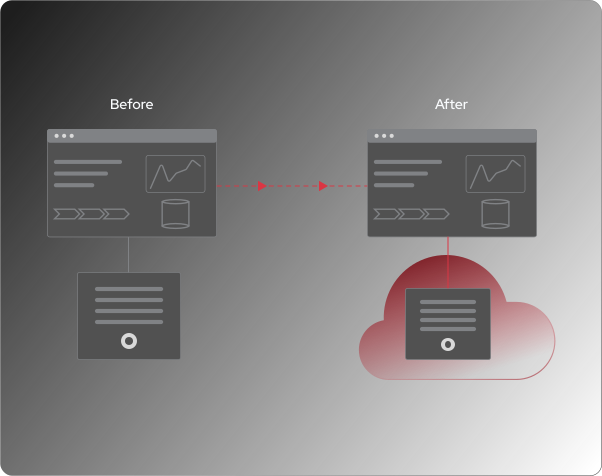
Refactoring involves improving the internal structure and code without changing the systems’ external behavior. Refactoring ensures your software aligns with current coding and performance standards. Tools like SonarQube and CAST Highlight assist in identifying areas for improvement which are then refactored by our teams. Refactoring enables businesses to achieve a more agile codebase capable of leveraging modern technologies like containers, microservices, and CI/CD pipelines.
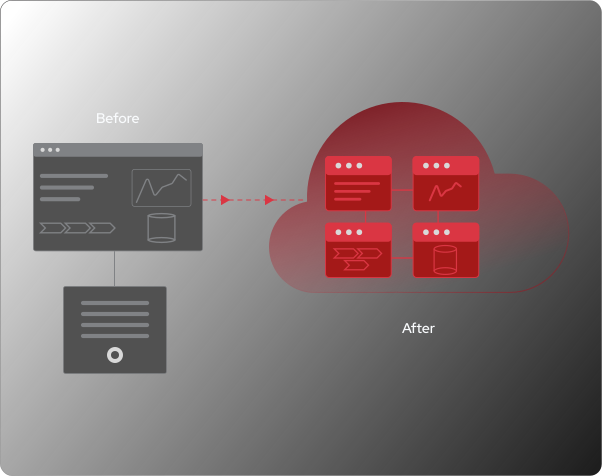
Also known as “lift and shift” this approach involves migrating an application to a new hosting environment, typically the cloud, with minimal changes to the code. Rehosting allows businesses to quickly benefit from the scalability, availability, and resilience of cloud platforms like AWS, Azure, or Google Cloud. Using tools like AWS Migration Hub or Azure Migrate, we seamlessly transfer your applications to the cloud while ensuring minimal disruption.
Re-platforming involves migrating to a new runtime platform and making minimal changes to the code. A popular example of re-platforming is Java applications migrating to different versions of the JRE runtime. Replatforming involves taking advantage of the new features the runtime provides and modifying code to drop deprecated features. In enterprise scenarios, re-platforming is a sensitive endeavor that often requires extensive regression testing to preserve application functionality.
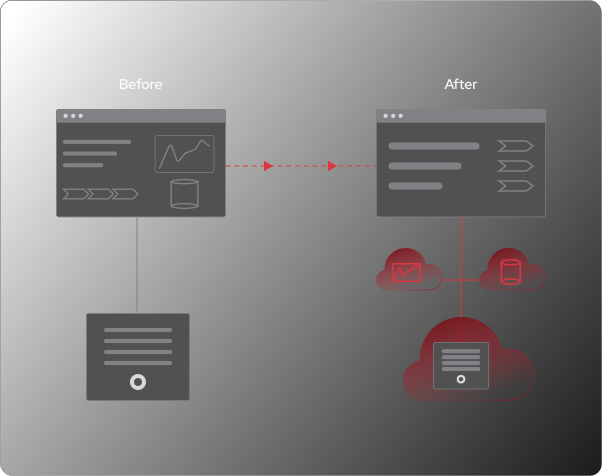
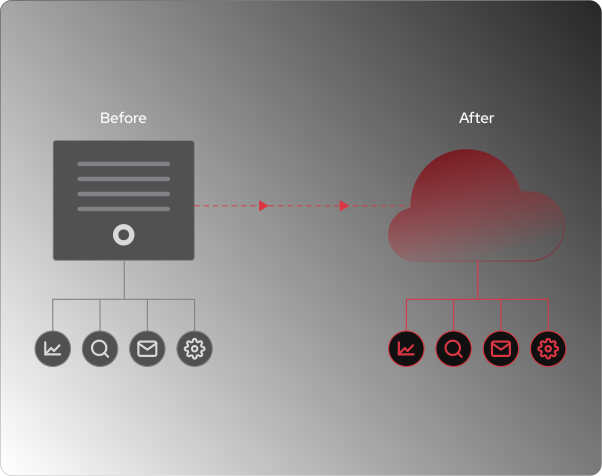
Rearchitecting transforms an application by redesigning its architecture to meet modern performance, scalability, and operational demands. This approach often involves transitioning monolithic applications into microservices or adopting event-driven architecture to align with modern cloud-native principles. Rearchitecting is suitable for applications that need a high degree of customization, scalability, or integration with advanced cloud services like AI/ML or IoT.
Rebuilding involves completely re-developing an application from scratch using modern frameworks, technologies, and design principles. This approach allows businesses to create tailored solutions that address evolving needs and take full advantage of the latest innovations in software development, such as serverless computing, AI/ML, or blockchain. Rebuilding is ideal for outdated applications that are too rigid or incompatible with modern platforms.
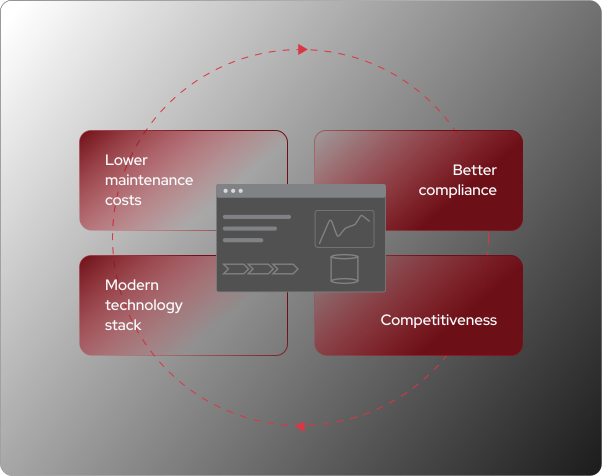
Replacing involves completely retiring an outdated application and substituting it with a new, off-the-shelf solution or a custom-built system. This approach is ideal when the legacy system no longer meets business needs or requires excessive maintenance. Replacement helps organizations adopt more efficient, feature-rich, and scalable solutions that align with current market trends.
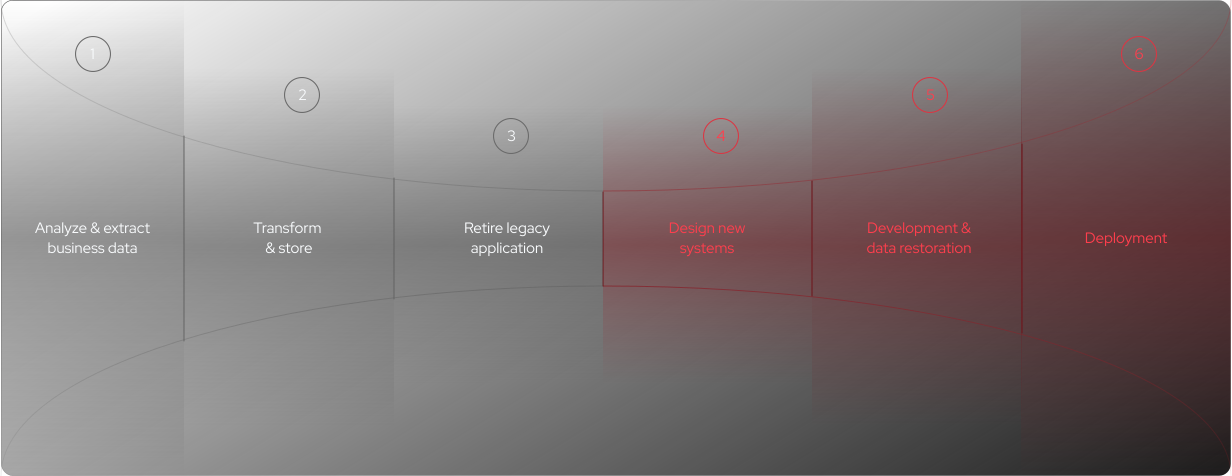

Skip the opportunity risk that arises from working with outdated legacy systems and poise your business for success with our legacy application modernization services. No matter the scale and complexity of your legacy system, our engineering team will chart out the best possible modernization approach for your business keeping the limitations in mind.















As a growing company, finding strong engineering talent at affordable rates is one of our biggest challenges. Cloudesign, a strategic partner to us, has provided Angular, React, Laravel and UI developers at short notice for a wide range of projects at Cactus Communications. They are quick to provide candidates, communicate promptly and keep the process low-friction. Cloudesign's engineers took ownership of our projects in a way that exceeded my expectations. We have been happy with the quality of the engineers as well as their management team.

ROI-generating digital solutions delivered to Industry leaders across 10+ sectors
Full-time engineering professionals
Unparalleled IT execution that’s forged lasting customer relationships
Read our newest articles for the latest trends and browse our FAQ for everything you need to know.
Explore our most recent blog posts and industry updates
No blogs found for this category.
Find quick answers to the most common questions about our application modernisation services and processes.
App modernization means updating legacy applications, architectures, code, infrastructure, databases, or integrations to meet current business and technology requirements. It can involve rehosting, replatforming, refactoring, rearchitecting, rebuilding, or replacing an application. The objective is to improve maintainability, scalability, security, integration, performance, and operational efficiency without unnecessary business disruption.
Application modernization services help organizations transform legacy applications using modern architectures, cloud platforms, development frameworks, APIs, containers, databases, and DevOps practices. These services can include application assessment, code refactoring, cloud migration, replatforming, API modernization, database modernization, monolith transformation, rearchitecture, and application replacement.
Examples of application services include customer relationship management, enterprise resource planning, payment processing, trading platforms, inventory management, e-commerce, document management, workflow automation, analytics, and customer portals. Application modernization services can update these systems by improving their architecture, infrastructure, integrations, databases, deployment processes, and compatibility with modern cloud environments.
Seven common types of application software are productivity applications, business applications, communication applications, multimedia applications, educational applications, database applications, and utility applications. Examples include office productivity suites, accounting systems, messaging platforms, media players, learning applications, database management tools, and system utilities. Classification can vary depending on the framework used.
The seven R's commonly used in application modernization are Retain, Retire, Rehost, Replatform, Refactor, Rearchitect, and Rebuild/Replace. The framework helps organizations decide what to do with each application based on business value, technical condition, dependencies, cost, risk, and modernization objectives. Terminology can vary between modernization frameworks and providers.
Application migration primarily involves moving an application or workload from one environment to another, such as from on-premises infrastructure to the cloud. Application modernization is broader and may include migration alongside code refactoring, architectural changes, API enablement, database modernization, containerization, DevOps improvements, and replacement of outdated components.
An application may need modernization when it relies on unsupported technologies, has significant technical debt, becomes expensive to maintain, cannot scale efficiently, lacks modern APIs, has slow release cycles, or depends on aging infrastructure. A modernization assessment can evaluate architecture, code, dependencies, security, infrastructure, integrations, and business criticality.
The main approaches include rehosting, replatforming, refactoring, rearchitecting, rebuilding, replacing, retaining, and retiring applications. The appropriate approach depends on the application's business value, technical debt, architecture, dependencies, modernization objectives, and investment constraints. Enterprises often use different approaches across their application portfolio rather than applying one strategy universally.
Yes. Legacy applications do not always require a complete rewrite. Organizations can modernize existing systems through rehosting, replatforming, refactoring, containerization, API enablement, database modernization, or incremental architectural changes. This approach can preserve valuable business logic while addressing technical debt, scalability limitations, integration challenges, and outdated technology dependencies.
Yes. Application modernization can create the technical foundation required for AI integration by improving APIs, data accessibility, application modularity, cloud scalability, security, and deployment processes. Modernized applications can then integrate AI or generative AI capabilities where they support specific business workflows, automation requirements, analytics use cases, or customer experiences.
Ready to discuss your next digital transformation project? Our experts are here to help you plan, design, and engineer solutions built for scale and performance.
Share your idea, and our team will schedule a discovery call to understand your goals and challenges.
Receive a tailored technology roadmap outlining architecture, tools, and timelines to bring your vision to life.
Once aligned, our engineers integrate seamlessly with your team to execute and accelerate delivery.
Send us an email at
sales@cloudesign.com
Cloudesign Technology Service Pvt Ltd is an enterprise software and AI consulting firm founded in 2015 in Bengaluru, with offices in Bengaluru and Mumbai.



Follow


Bengaluru:
BDA Complex, AISHWARYA, #70, 7th Cross, 16 B Main, 4th B Block, near Koramangala, Bengaluru, Karnataka 560034
Mumbai:
Ajmera Sikova, 606, Ghatkopar West, Mumbai, Maharashtra 400086
© 2026 Cloudesign Technology Service Pvt Ltd. All Rights Reserved